
Buying a Short-Term Rental on Topsail Island: The Levers That Make (or Break) Your Cash Flow
We’ve all seen it. Someone buys a gorgeous beach house, nails the décor, adds shiplap in all the right places… and then wonders why the numbers feel tight. Here’s the scoop: when it comes to buying a short-term rental on Topsail Island, your revenue is decided long before the throw pillows arrive.
If you’re underwriting a property with plans to STR it, you’re not just buying a beach home—you’re buying an income-producing asset. And in this market, it’s absolutely possible to cash flow. But only if you pull the right levers from day one. Today, we’re breaking down the ones that matter most so you can invest with confidence (and sleep well at night).
Bed, Bath & Guest Count: Your Revenue Engine
When evaluating a short-term rental on Topsail Island, your bedroom and bathroom count is your primary revenue driver. Not the backsplash. Not the paint color. Beds and baths.
Why Bedroom Count Matters
On platforms like Airbnb and VRBO, travelers filter by guest count and bedrooms. A 3-bedroom home competes in a completely different revenue bracket than a 4-bedroom home—even if the square footage is similar.
CRSJ Tip: Always analyze what guest count the home can comfortably support without feeling overcrowded. There’s a big difference between “sleeps 12” and “should it sleep 12?”
We’ve seen properties try to squeeze in extra bunks to inflate occupancy numbers. That’s like cramming extra seats into a sports car—it technically works, but nobody enjoys the ride. The result? Lower reviews and weaker repeat bookings.
Bathrooms matter, too. A 5-bedroom with only 2 bathrooms can bottleneck the guest experience (and your reviews). Ideally, you want ratios that support the occupancy you’re marketing.
For deeper insight into how layout and design impact revenue, check out our related article: “How Small Design Decisions Can Increase STR Revenue by 10–20%.” Those details compound once you’ve chosen the right bedroom count.
Underwrite with Real Data (Not Optimism)
If you’re purchasing a short-term rental on Topsail Island, your underwriting needs to be grounded in actual performance data—not seller projections or hopeful estimates.
Use Tools Like AirDNA (Correctly)
Platforms like AirDNA provide market-wide revenue data, occupancy rates, and average daily rate benchmarks. They’re incredibly useful—but only if you analyze comparable properties properly.
Look for:
Same bedroom/bath count
Similar proximity to the beach
Comparable amenities (pool, elevator, beach access)
Similar condition and age
CRSJ Insider: A home one row back with private beach access may outperform a closer property that requires crossing a busy road. Nuance matters.
This is where professional revenue analysis becomes invaluable. We regularly pull performance data, compare seasonality trends, and stress-test projections to ensure investors are underwriting conservatively.
Because here’s the thing—you’re underwriting it after all. Hope is not a strategy. Data is.
Flood Zones & Insurance: The Silent Profit Killer
Beachfront is beautiful. There’s no denying it. But before you fall in love with oceanfront views, pull the flood zone maps.
On Topsail Island, properties may fall into higher-risk flood zones, significantly increasing insurance costs. A hefty flood insurance premium can quietly eat away at your net cash flow—sometimes by thousands annually.
It’s the kind of detail that doesn’t show up in listing photos but absolutely shows up in your P&L.
We’ve seen buyers stretch for a premium oceanfront property, only to realize later that insurance, maintenance, and exposure risks materially impact ROI. That doesn’t mean “don’t buy oceanfront.” It means price and underwrite accordingly.
Sometimes, second-row properties with strong beach access deliver stronger net returns because operating costs are lower while guest demand remains high.
Walkability & Beach Access: Demand Drivers You Can’t Ignore
Here’s a simple truth: people come to Topsail for the beach.
Bay views are lovely. Sound-front sunsets are magical. But when travelers are booking a short-term rental on Topsail Island, proximity and ease of beach access drive booking decisions.
Ask yourself:
Is there private beach access?
Do guests have to cross a busy road?
How far is the actual walk, realistically?
Is the path convenient for families carrying chairs and coolers?
Walkability is one of the most consistent demand indicators we see. A short, safe, simple walk to the beach often translates into higher occupancy and stronger peak-season rates.
It’s the difference between “steps to sand” and “bring a wagon and good luck.”
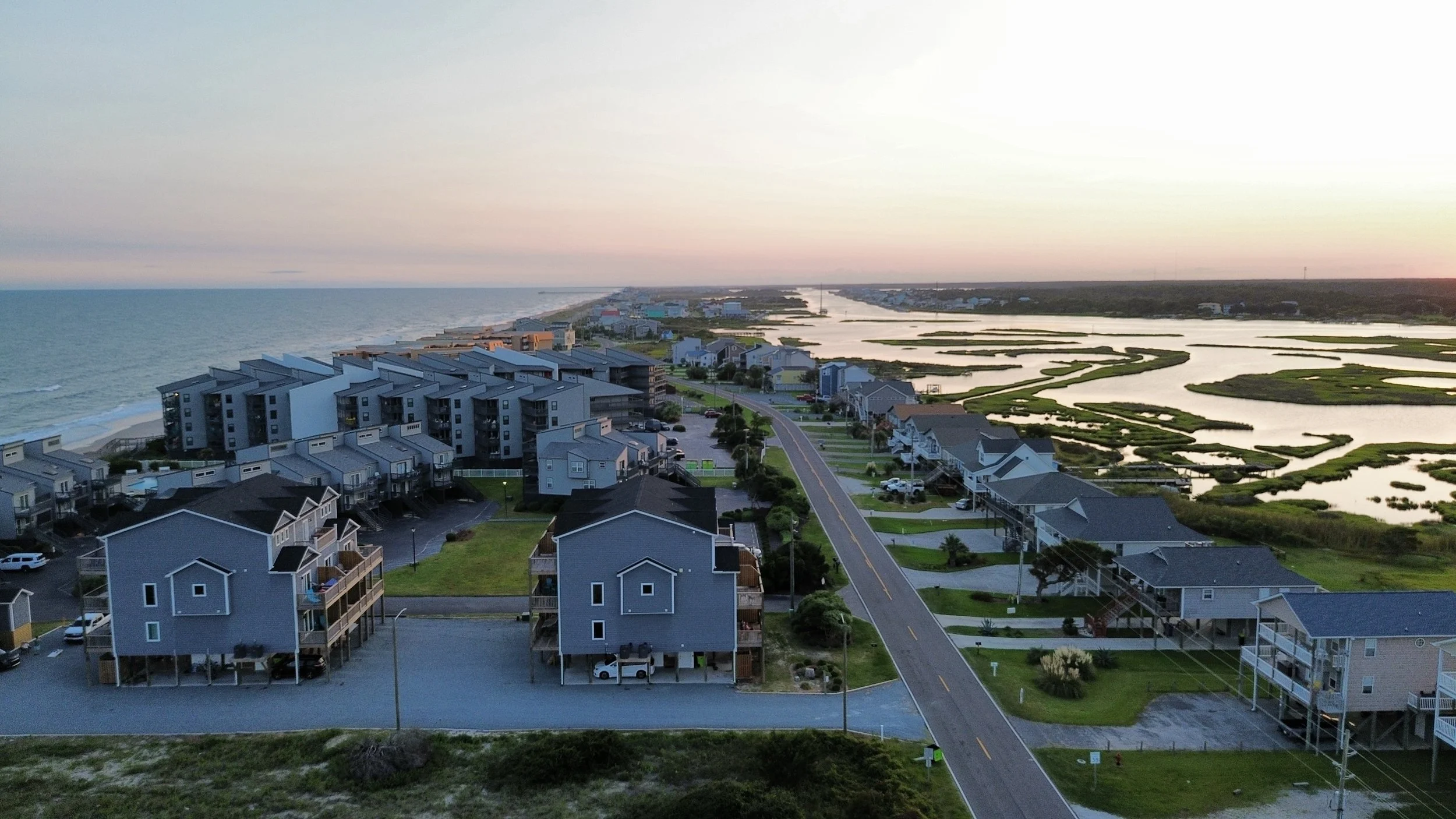
Aerial view of New River Inlet Road on Topsail Island showing oceanfront homes on one side and sound-side properties along the Intracoastal Waterway on the other—highlighting how second-row and sound-side homes can offer ocean views, sunset views, and strong short-term rental potential at a more accessible price point.
Amenities That Move the Needle
Not all amenities are created equal. Some look good in photos. Others materially increase revenue.
Pools: A Major Competitive Advantage
On Topsail Island, a pool is one of the most powerful differentiators—especially for larger homes.
Why?
Extends the shoulder season appeal
Provides flexibility during red-flag surf days
Appeals to multi-generational groups
In competitive sets, we consistently see homes with pools command stronger rates and occupancy. Yes, there’s added cost and maintenance—but the revenue upside often justifies it when underwritten properly.
Elevators, Outdoor Living & Parking
Other high-impact amenities include:
Elevators (especially for 3+ story homes)
Covered outdoor entertainment areas
Adequate parking for large groups
Outdoor showers
Again, analyze your competitive set. A 6-bedroom home competing against others with pools and elevators will feel incomplete without them.
The Power of Smart Layout & Guest Flow
Even with the right bedroom count, layout influences perceived value.
A home that comfortably supports its advertised occupancy—ample dining seating, functional kitchen space, multiple gathering areas—will outperform one that technically sleeps 12 but only seats 6 for dinner.
Guests notice when homes feel cramped. And reviews reflect that.
This is where thoughtful design and smart furnishing decisions can unlock an additional 10–20% revenue bump (see our related article mentioned earlier). But remember: design optimizes performance—it doesn’t rescue a flawed purchase.
Buying right is step one.
Seasonality & Realistic Cash Flow Expectations
Topsail Island is a highly seasonal market. Peak summer weeks drive a substantial portion of annual revenue.
When underwriting a short-term rental on Topsail Island, you need to understand:
Peak vs. shoulder season performance
Holiday booking trends
How amenities impact off-season demand
A property with a heated pool or strong indoor gathering space may perform better during spring and fall. That incremental shoulder-season revenue can make a noticeable difference in annual cash flow.
Cash flow is absolutely achievable in this environment—but it requires disciplined underwriting and realistic expense forecasting.
Think Like an Investor, Not Just a Buyer
It’s easy to shop emotionally when ocean views are involved. But successful STR investors ask different questions:
What is my target annual gross revenue?
What are realistic occupancy rates?
What are true operating costs (management, cleaning, insurance, maintenance)?
How does this property compare to its top five competitors?
The goal isn’t to buy the prettiest house on the block. It’s to buy the most profitable one in its category.
Because at the end of the day, your return isn’t determined by how great it looks on Instagram—it’s determined by how well it performs on your spreadsheet.
Conclusion: Buy Smart, Then Optimize
Buying a short-term rental on Topsail Island can absolutely be a smart, cash-flowing investment—even in today’s market. But only if you get the fundamentals right:
Strong bedroom/bath configuration
Real, data-backed underwriting
Careful flood zone analysis
Prime beach access and walkability
Revenue-driving amenities like pools
Design and décor matter. Marketing matters. Management matters. But none of it can fully compensate for buying the wrong asset.
If you’re considering a purchase and want a data-backed revenue projection or investment review, let’s talk. We’re happy to analyze potential properties, evaluate competitive performance, and help you make a confident decision.
Because the right beach house doesn’t just look good—it works hard for you, season after season.
Want a clearer picture of your rental’s revenue potential?
Download the Topsail Revenue Insider — a free, instant-download guide that reveals the most common ways local properties quietly underperform and how owners fix them.